

Cognitive Biblical
Therapy Coursework
Counseling Through God’s
Transformative Word
Course 4, Chapter 19
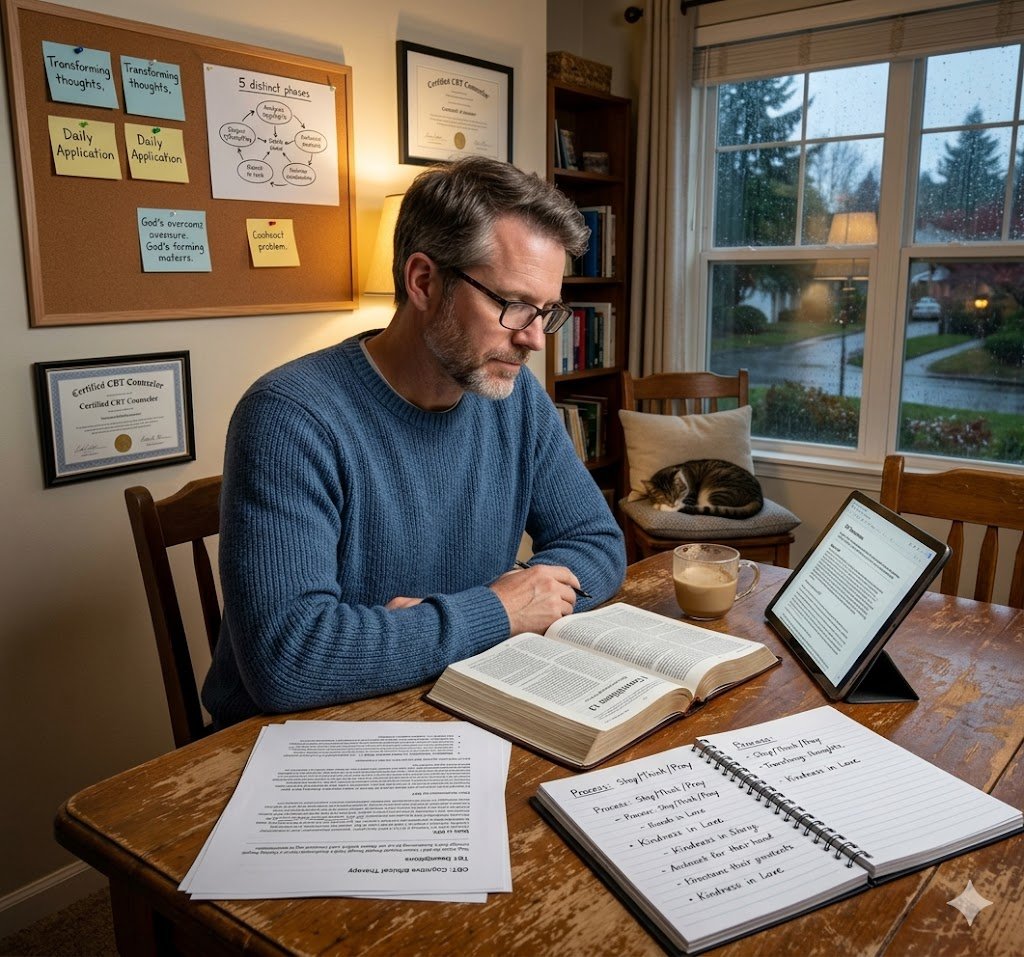
Welcome to Section 5: General Counseling Issues
Chapter 19 Abortion
Unexpected pregnancy can be a joy for women, though others may view it as an inconvenience and unwanted. Having an abortion my be their immediate solution from a poor understanding of God’s love and pressure from others. Dr. Wilkinson discusses how counselors can use CBT to lead a client to find healing and wisdom through God’s Agape love.
Essay Questions: Answering the section questions (red buttons) is a great way to prepare for the end of the Chapter Quiz. Chapter 19 questions require you to analyze the case study and apply both present and previous course understanding, while using common sense. The section questions will provide Dr. Wilkinson’s feedback to your answers.
Quiz Requirement: At the end of the Chapter, a score of 75% is necessary on the Chapter Quiz in order to access the next chapter.
Account Access: You must be logged into the coursework page to take the quiz and advance.
Chapter 19
Abortion
Impact of Abortion
In section 5, the focus will not be on relationships, but life issues that cause the presenting problem and how it relates to the level of the client’s spiritual knowledge and faith. They focus on what caused the problems, and see the problems that result from not having a functional relationship to God.
The next Case Studies is about the life issue of abortion, which is Case Study 19. This issue can be found in the Symptoms and Treatment Text (Materials tab). Our client is a female who is Passive-active. The symptoms of dysfunction include a false concept of love tied to being sexual. The issue of abortion is really the issue of love; love gone wrong in the sense that there's an initial concept of love that, for the most part, has tied the woman to the whole issue of sexuality, instead of spirituality. With the false concept of love, abortion is the answer to her view of pregnancy as the problem. This issue is very complex and can have many contributing factors. She can be very young, someone who is unfamiliar with sexuality, she can be carelessly immoral, she can be married and pregnant with a baby who has a birth defect or she may have a high-risk pregnancy. Historically, after a diagnosis of a birth defect, doctors often advise the woman to have an abortion as the best outcome. The diagnosis can be something that's relatively clear cut, such as a deformity resulting in a pre-born death, or no survival after birth. Rather than focus on different situations that can result in abortion, we have to talk about the basic principles of abortion.
Most abortions are results of false concepts of love, one’s perspective of God creating life and the sexuality that enabled the pregnancy, which is trying to fill the human void for love that is a spiritual need. Another concept lacking understanding is the concept of forgiveness, loss and regret. Most often, the client is suffering with an extreme, pervasive, and long-standing sense of guilt, with thoughts like: I've killed my child. God can't forgive me. I've wrecked my life. This will impact my current relationship. Do I deserve a loving relationship, a second chance, even having other children? These unresolved guilt feelings and thoughts can be crippling. She has an emotional blind spot. She got into repetitious thoughts of what she has done.
The next point on the list of dysfunctions, is a lack of understanding of eternal life, especially as it relates to the aborted child. She now has two problems. The first is the problem of her own spirituality. Either the client lacks any spiritual knowledge or spiritual life, or her spiritual life is nominal or liberal. Most likely, she has her own spiritual issues which led her to the choice of abortion. Her second problem is a sense of loss, and guilt from killing her child. There will be many unanswered questions about where the child went, and if she will ever see the child. She will need to grieve the loss of the child she loved while she carried the child within her own body, depending on the length of the pregnancy. She had a sense of ownership, and now a sense of a void.
One of the myths and spiritual distortions involved in a pregnancy from a rape is that she will feel better after the abortion, and able to recover more quickly from the trauma. The opposite is true; it just compounds the problem. There's already been an intrusion through the rape, a violent act, and now there's a second violent act in the abortion process. Instead of having any good result, the woman feels violated from the rape and then empty now with the child gone. What general studies show is that if a woman carries the child to term and adopts it out, or even chooses to keep the child, the end result is good, godly and holy and wholesome. God promised to bring good things from bad experiences. This is a great example of the paradoxes of His grace and goodness.
Next in the symptom list, you will see the person’s view of pregnancy, whether it is the girl or woman, involved with a man, who has parents, grandparents, relatives and friends. Both the individual and others involved, especially the man, play a big part in the girl/women’s decision. Whether it is an inconvenient or unwanted pregnancy, the view of the baby, life and adult responsibility will also influence the decision. Let’s not forget the emotional, mental, social and political pressure upon a woman considering an abortion or the parents of a teenage daughter. When a woman has an unexpected pregnancy, in or out of wedlock, her values and emotional/spiritual/social security are tested; same with the family. An Agape love perspective will see the pregnancy as an opportunity while a conditional love will view it in various ways, some as an inconvenience.
The last symptom says multiple relationships, usually sexual. It can be a pattern if the whole basis for a relationship is being available sexually. This is an attempt to find security, strength or peace, but usually comes with irresponsibility for pregnancy prevention which is part of that lifestyle. Some of you have never lived that lifestyle. Unfortunately, I did for a number of years, and there's a level of irresponsibility that I lived in. When my life was in its most difficult stage, I would drink a quart of whiskey every day, or use a substance to the extreme or sell it. Many times, I would wake up in a place I couldn't remember going to. Once I woke up in my car, in a ditch, just passed out and ran off the road. When I tended a bar, there was extreme violence, weapons available, or excessive quantities of substances, and that pattern became normal.
In this type of lifestyle, multiple relationships that are sexual, become normal. Seeking a feeling of love through being sexual is normal. A woman's willingness to participate in that type of relationship brings the expectation of being sexual, even if you just met an hour ago. And that type of lifestyle does not generate pre- planning or organized thought. So, if you wake up in someplace that you're not familiar with, and your pregnancy prevention is not with you, and the man wants to be sexual again, you just are. Doing that over a number of years, many pregnancies will result, thus many abortions because of that irresponsibility. It's not so much that it's a pre-planned decision to get pregnant. It's more the result of living a lifestyle that does not have foundational principles based on thought, consistency, or treating yourself well. Instead, she lives for the instant pleasure, which is easy to do if she is an emotionally based person. This type of lifestyle is rife with heartbreaking experiences that seem to be never ending.
Fully answer the following question from the content you just read and submit your answer to find your score and Dr. Dan's answer to the question.
One of the major issues for a woman that has an abortion will be guilt and shame. What is the woman thinking in these cases and how will you address this to her?
Pasting is disabled for this answer box. Please type your answer in your own words.
Dr. Dan's Answer:
She can think she has murdered her child or children, that no one could ever love her because of what she has done, that she is somewhat cheap or less worthy, and that she has to build relationships upon being sexual rather than any other standard.
The counselor will teach her the truth and value of her worth, what the basis for a relationship is (starting with a relationship to Jesus Christ through salvation), how to confront choices so that the current pattern of choices is broken, and how to work with the Presence of God the Holy Spirit within the client's mind, emotions, and soul.
Fully answer the following question from the content you just read and submit your answer to find your score and Dr. Dan's answer to the question.
A woman that has gone through an abortion or abortions may have experienced many broken relationships in her life. What types of relationships will this woman or has this woman experienced in her past?
Pasting is disabled for this answer box. Please type your answer in your own words.
Dr. Dan's Answer:
They can range from living with a false sense of control (being in control of her life) to being under the dominant control of a man. The common thread will be a sexual bondage -- using and being abused rather than having a healthy, whole relationship. Living in broken relationships within her community can lead to sexual assault, unexpected pregnancies, and a chaotic lifestyle.
Treating the Client
The Treatment Text says, evaluate the concepts of Agape love through the questionnaire and determine the personality through the questionnaire. Analyze the biblical concepts of forgiveness and eternal life and apply them to the individual situation. Next, explain the concepts of sexuality humanly and spiritually. If you look at your case study, this particular woman had three abortions by the time I met her. She wasn't married and had quite a bit of substance abuse. She was somewhat suicidal. She had moved back from New York, to live with her parents who were Christians. Her father had been a missionary, and lost his wife in the field and remarried fairly quickly. The daughter was about 12 at the time, and this huge change had been very difficult for her. She was greatly offended by his remarriage. Unfortunately, the woman who he married tended to be emotional, needy and insecure. Whereas, the daughter tended to be strong-willed and demanding. The new wife quickly caved to the daughter’s demands, and was controlled by her. The husband thought his wife was being mistreated, and rescued her whenever this power struggle occurred. He became enmeshed in the hassles between his wife and his daughter trying to protect them both. It stayed that way for years. Unfortunately, I could not help the step-mother to respond differently. The father did, and got out of the middle and stopped being the referee between the wife and the daughter.
The daughter, though, didn't respond as well as I'd hoped. She had a need for a psychiatric evaluation and the prescribed medication helped her quite a bit. But when we got to dealing with her problems, she improved to a point, but was unwilling to continue to counsel. When I met her, she was sexual with her boyfriend who she fought with quite often. That pattern of fighting with him was very destructive. In an attempt to get him into counseling, I talked with him, but unfortunately, he didn't have any willingness to be submissive to much of anything. He was convinced that she was the problem and would not counsel. That led to their eventual breakup. And when that happened, she was so fragile in her emotional state, that she decided to leave home and quit counseling. She went back to the lifestyle of immorality. She called me a few times, and then I didn't hear from her after that.
Another element in this case is that she had been living in a home in New York, with a number of other people, where she was being physically and sexually abused. That is when her father intervened and got her to come home and get some help. When you look at her questionnaire results, her highest scores are in: C envy (15), D boast (16), I keep no record (12), and L protects (12). But her scores in relation to all of the potential scores of 25, her highest scores are pretty much in the mid-range (5-25), which shows that her knowledge of what God is like was very poor. That might seem odd, given her father was a missionary. Her father had been very headstrong in a lot of ways. With the death of her mother, the daughter lost her emotional support, confidant, and source of tenderness. The hasty marriage to another woman who was not an emotional support, left the daughter confused, angry and disconnected. Those overwhelming emotions turned her against God, thinking God didn’t care about her and she retreated emotionally within. Probably with a better source of support, she would have survived the death of her mother. Her personality type is Passive-active, so she was more passive to begin with, but became more active when the step-mother entered her life, and she became an absolute bully. She would scream and be belligerent which characterized her adolescence and her young adult life. When I met her, she was about 26 and her life had been one unending fight with anybody and everybody she met. She still retained some of these characteristics of Passive-active, but her basic attitude was combative from the time she met me, questioning my authority and my credentials. She did soften somewhat, but every time I met with her, it was like going through a 15-round fight, that drained and exhausted me. The median scores are: A patience (11), B kind (10), E pride (10), F rude (9), G self-seeking (10), H easily angered (9), and M trusts (10). Her lowest scores were: J-K delight in evil (8), N hopes (5), O perseveres (5), and P never fails (5). Remember, you can see a spiritual tendency on the questionnaire that is different from what you see in her present behavior. She obviously held a grudge against her dad, but that's different from her deepest motivation. So, her deepest desire was to not keep records of wrong, to forgive Dad, to forgive herself, to have a sense of peace. She also had a desire to be gentle and respectful, but that wasn't being expressed.
Looking at the pattern of her scores there is a clear indication of her personality being Active- passive. In other words, there's only one point difference across patience, kindness, pride, rude, self- seeking, and easily angered. Trust, which is another indicator here, was higher. Typical of someone who didn't want to know God, the trust score would have been lower that the others. Her deepest troubles were in being negative, sort of always gloomy, and not having a sense of hope, doing things on her own strength, and feeling like a failure. I explained all of this to her and showed her the concepts of Agape love, and explained her personality type. She was a blend of a fence sitter, quiet and withdrawn and the active side of being demanding and even accusatory. She had a good sense of right and wrong, discernment, but because she made such quick choices from the active side, she would miss seeing the truth in a situation. This tendency had to be applied to her spiritual self, and also the abortions in relation to her spiritual life. She believed she wasn't saved. I explained the plan of salvation. She had gone along with saying she was to make her dad happy. She said, “No, I'm not going to do this just for him.” After I explained that she could receive help and guidance from God through salvation, she accepted the Lord as her Savior. Not in the session with me, but came back and reported that she had prayed that way. That was good. That was necessary, for the opening for the Holy Spirit to work with her on these issues. Her biggest issue was how to hear the Holy Spirit. She didn't read the Bible much, so I encouraged her to do that, and I had to coach her on how to respond through the process of patience rather than emotional anger. We did a lot of role plays. Her presenting issue was abortion, but it really was the lack of knowledge or inability to apply that knowledge was the underlying problem. Practice spiritual knowledge that it takes to understand how to pray, how to think, how to hear the Holy Spirit, how to live by the principles of being submissive to God, and being Christ-like. I worked with her to develop those things.
Fully answer the following question from the content you just read and submit your answer to find your score and Dr. Dan's answer to the question.
How is God's solution for abortion salvation, forgiveness, and learning from patterns of sin in our life? How does each of these generally apply?
Pasting is disabled for this answer box. Please type your answer in your own words.
Dr. Dan's Answer:
Accepting Jesus as Lord and Savior is God's solution for living free from sin, facing life's choices, and being empowered by the Holy Spirit. Salvation is necessary for forgiveness of sins, which brings spiritual peace as the foundation for freedom from guilt, shame, and self-hatred. Sanctification and spiritual transformation are involved in breaking patterns of sin and developing the ability to choose wisely.
Forgiveness and Grieving
When the client asks, “What about the issues about the babies? What about what I did? What about my guilt?” You need to explain the basic facts of salvation and forgiveness. If she was not saved, then being saved is going to bring forgiveness for the choice to abort the child. If she was saved, and aborted the child, it was sin and it was wrong, and a result of being sexually immoral. Remind her, 1 John 1:9 says, “If we confess our sins, He is faithful and just to forgive us of our sins and to cleanse us of all unrighteousness” (ESV). She needs to repent and ask for forgiveness from God. For the woman who was unsaved when she had the abortion, help her face the fact that she made a choice out of ignorance to abort her child. Though if she knew it was wrong, she willfully did it, then she needs to ask God for forgiveness even if she did this out of ignorance, was pressured through a manipulative situation, she still needs forgiveness. She entered into an immoral relationship seeking security, and didn't realize her choices were leading her to deeper insecurity.
Once she learned what love really is, let’s work with the relationship you are in now. Let's get your boyfriend into counseling. Let's set up a separation. Let's terminate the sexual part of the relationship and see if you two can form a new relationship based on being Christ-like and submissive to God, and deal with your problems, finding your security from the proper place. You have to examine the facts behind the guilt, and deal with it so that there's a new reality for life based on what love means, and how you relate to God. We addressed her guilt by talking through each of the abortions applying forgiveness to each one. In one case, she was kidnapped, restrained and used as a sexual object. In this situation she didn’t willfully enter into it, knowing that there would be physical and sexual abuse. But her need for forgiveness went back to her decision to be rebellious. We had to talk about what she did, when her dad did what she didn't like. What she could have done rather than act out. She knew the Gospel, but chose to ignore it and do her own thing. Through our discussions we discovered that her dad didn't represent the Lord clearly. Her mother's death was very unfortunate and sad. Her step- mother's difficulties were also sad. Her choice to rebel was not appropriate, but understandable, because of her lack of knowledge and her emotions and her tendencies. That rebelliousness led her into her first situation, where an abortion occurred. She was with people who were also rebellious and lived pretty wild. One of the things she called normal was sexual bondage and physical abuse. In that situation there was a mixture of her responsibility and being a victim.
She had to think and pray, and work through patience, ask God for forgiveness, and understand how the Holy Spirit would help her see what was true and false. Her second abortion resulted from her being lost and needy. She met someone who was much like her: not knowing the Lord, and being rebellious. They began living together and she became pregnant. He wanted her to get an abortion and she wanted him, so she got the abortion. We went back to sort out the facts of the situation, what did she know and do, and what was her responsibility. What were her spiritual choices? Was she selfish, rude or proud?
Her third abortion was pretty much the same as the second one, with pretty much the same results. Your work with the client is to help her unwind the ball of facts and separate situations involved which led to the abortion and their results. The next task is teaching the concepts of the Gospel, Jesus’ payment for our sins, His forgiveness and eternal life. Forgiveness is not God's amnesia in relation to our choices. God wants us to get His perspective on what happened, so that when the situation comes again, or temptation arises again, you can look at that whole situation, and remember what He taught you. Much like looking at an object out of your reach: you see it and know it's there. You can describe it to me, but you can't reach it. And that's the other half of what forgiveness is about. So we are to give it over to God, who forgives us, cleanses us. We are not supposed to wallow in the misery and guilt of the problem endlessly. God loves constantly, and God restores. God is good. God heals. Anytime we're working with a client, the whole focus of CBT is to get them into that working relationship with the Holy Spirit, so that the power of God, regardless of the problem, can be given to them. God’s goal is for us to understand His mind, truth and wisdom when dealing with the problem, and not be buried by it or burdened with it, or endlessly repeat the whole cycle of suffering and confusion over an issue.
Teaching the client about forgiveness includes some basic facts. God's grace will be more than adequate to cover your sin. The Atonement, the death of Jesus, Christ, will give you a second chance. You will be forgiven. Your sins will be washed whiter than snow. In Psalm 51:5, David makes a statement after his sin with Bathsheba. He says, “Surely I was sinful from birth, from the time I was in my mother's womb.” And then he says, “Lord, cleanse me with hyssop, and I will be clean, wash me and I will be whiter than snow.” He's affirming the fact that, yes, he sinned, but yes, God can forgive if he will be repentant and face his problems. And not only can he do that, but he says in verse 10, “Create in me a pure heart, O God, and renew a steadfast spirit within me.” And in verse 11, “Do not cast me from your presence or take your Holy Spirit from me.” In verse 12, “Restore to me the joy of your salvation and grant me a willing spirit, to sustain me.” God is affirming the fact that in forgiveness comes joy, and in a pure heart comes the ability to understand the problem and to go on and live a life that's whole, holy and healthy.
So that's the idea of forgiveness means, yes, you have had three abortions, but you are choosing to find out why, and God is going to help you to be restored, and you don't have to do this again. And you will be okay, and you will even discover and live in a new freedom in Jesus. Try using the object out of reach as an example of the distance from or sin that forgiveness brings. It helped her to realize that she is forgiven. She has learned and she is moving on. Some women need more help, such as a women’s Christ-centered, self-help group, who have had abortions, and other groups like “Grief Share” to hear how other women are discovering forgiveness and freedom from guilt.
She also needed to understand eternal life. She has to understand that her children are not dead. Those children are very much alive and with God. God does not hold the unborn accountable for sin, because they do not know the gospel to reject Jesus and salvation. This is very comforting to a woman to say two things: “Your children are not dead, but with God. Because you've chosen to enter into an eternal relationship with God, you will see your children again.” In other words, you will be a family in heaven. You will have those children with you for eternity, and they will not be mad, or hate you. There will not be anything negative in those children, who will love you very much. That's a real strong motivation for becoming a Christian, because that sense of loss now is replaced with a promise. It's much like Job who lost his ten children all at once. When Job was given even more than he had before, he had another earthly family but also heavenly family. The only difference here was he had to wait to get to heaven to be with him.
Another example is King David, after committing adultery, being responsible for the death of the husband and then the loss of his newborn child, he said in 2 Samuel 12:23, “I shall go to him, he shall not return to me.” David knew he would see and be with his son in heaven for eternity. That's the bottom line to abortion; the woman will have those children in heaven. Her own decision to enter into eternal life, and the fact that God, in His love and kindness, has already welcomed the aborted children into heaven with Him. It is very important to help her understand that the forgiveness of God comes from the decision to face her problems, and to be accountable. He'll give grace to forgive the sin, and he'll give grace to continue to empower the woman to have that spiritual relationship.
Continuing our discussion of treatment for abortion, the Treatment Text also suggests that you don't hesitate to present the gospel to your client. This can be a place where you're a bit hesitant, but if that's their basic need, you have to tell them. You have to be straightforward, “You need to be saved. You need to be changed: your spirit, soul, your person, needs to be changed from being selfish to being centered on Christ, willing to think, act, do, and be like him.” Make sure that you don't hedge on that, even if you feel inadequate, scared like you'll be mocked or ridiculed. I know it's not easy, but that's your place.
As a pastor, seminary student or lay leader, sharing the Gospel in a counseling setting may be within your comfort zone. As a professional counselor, you may have been taught the principle of being “non-directive”, allowing the client to access their own knowledge of truth inside themself. Or the aspect of working with the client’s agenda, rather than your own agenda. If so or you are uncertain about this or want to refer them to a pastor, consider this perspective. God trusts you to share His story of Agape love with whom He brings to you. Without God’s Presence in your client’s life, your counsel will only be for symptom relief, behavior modification or cognitive restructuring at best. The aspect of you sharing the Gospel is a significant part of the therapeutic process, not being subject over their will, using undue influence or against any code of ethics. Then the format of sharing the Gospel can be done in various forms (list of Scriptures, pamphlet, audio file, email, etc.) as well as a direct, face to face explanation of the Gospel, the Romans Road and how to accept Jesus as their Lord and Savior.
That's the point of the process of CBT, that's your job. If you don't establish that, the fact of salvation, then she won’t hear you. You're talking to them spiritually, and she is dead. She doesn't have ears to hear, eyes to see, or a mind to grasp. Spirituality, Agape love and transformation are foolish to her. You don't have to run that into the ground. There may be times when the person says, “I'll talk to you, but I'm not ready to make that decision,” and that's fine, but make sure you get the information to them. You'll be amazed at how many people have never been presented with the Gospel in a clear, practical, simple way. Help them understand that a prayer of salvation is simple. It is, “Jesus. Forgive me of my sins and be my Lord and Savior, and I commit my life to you, to following you, to understanding this Scripture.” Make a prayer that is simple for them, help them to understand that that's their need. If only, “God, I need you in my life” is a good start. That's what needs to be said and done.
In your own words, answer the following question and submit to record your response. This question is for your personal reflection -- no score or model answer is given.
In 25-50 words, what would you say to introduce the Gospel to a client who has not been saved? Do you believe it is your role to share the Gospel with a client who is not saved?
Pasting is disabled for this answer box. Please type your answer in your own words.
Continuation of Treatment
The next step in treatment says, explain the concepts of sexuality humanly and spiritually (see Chapters 4, 5 & 16). Again, you're going to be amazed, because there will be a very good chance that the woman has had a sense of her need for security spiritually and wanted that. She has never understood the simple basics of what men think of when they are sexual, what they say they want. The social stereotype that we see in the movies is a woman who is always wanting the man, willing to be sexual, even with many people who are immoral. She will think that's what men want. She won't understand unless you explain to them about what a man is, where a sense of love comes from, what the sexual act means. She needs to learn how the woman is different. That most men think that they have to perform, because performance is being sexual and not a place of tenderness. It's a place of putting on a mask and going through the motions, thinking that her almost pornographic performance is required for him to be fulfilled. Help her understand that she doesn't have to perform through an orgasm. It is the woman’s right to not require one, and still want to make love to her husband.
Be sure she understands, she needs to be loved through other means than sexual activity. She needs to have the man pray with her, go to church with her, say he is sorry, listen to her, and be mutually submissive to each other. Loving is also working together on their spiritual growth. Often, the woman is conditioned to being yelled at, harassed, picked on, being sarcastic and rough, and being treated roughly. Help the woman understand that she doesn't have to prostitute her own body, by the way she dresses, acts, or wears makeup. She can be a lady, which is acceptable: that's the way it's supposed to be. Many women have never learned that from their parents or witnessed a loving relationship between a man and a woman. It is important for her to understand that the man is not necessarily lusting after her, just because he desires her. In other words, you're trying to help them prepare for a godly relationship in which the understanding allows them to have a good, normal relationship, where there can be calmness and peacefulness.
This particular woman was very aggressive and strong, and could be dictatorial, and naggy as a means to protect herself. Her boyfriend gravitated between wanting to be with her, and almost repulsed by her viciousness. It was an amazing fact to her that his level of desire for her was tied to the way she treated him verbally. She had never linked love or sexuality with being Christ-like or godly in her entire life. The other factor in treatment says, to explain the concepts of grieving over the loss of a loved one and how it applies to this situation. She may have not allowed herself to grieve over the loss of the children, if there are multiple abortions. You need to explain the process of grieving: accepting the loss, dealing with the emotions, adjusting to a world without that person, addressing questions about God and heaven, continuing to move on with life. If this has not been addressed, then grieving has been suppressed, deferred or denied.
A woman may have times where she cries a lot, she mourns, she is angry at God. She may have gone through this already and then repeats the cycle. But if she is in a situation of just surviving, performing and living, most likely her grief has not been addressed. It is like getting the abortion in the morning on Monday, back home or to work, then by Friday, you're in the bar drinking, and you're facing the same need, temptation and choice. Giving in to that lifestyle, doesn’t give you time to face the reality of the death of your child and dealing with the emotions from it. That's the last thing in the world you want to do, because if you let yourself think, then you're going to have to face things or feel things. And you don't want that. That's why people keep themselves anesthetized with drugs, alcohol, sex, emotions, power and money. You've got to keep the brain numb and dead, or else the Holy Spirit will have the chance to bring to the conscience, the reality of what you're doing, into your mind. And that's too scary, and that's not acceptable. She may have to face grieving and go through that, and you work with her on that, talk to her, listen to her, and use this for the process of patience to readdress those emotions. Go back to the realities of salvation, righteousness, forgiveness and the leading of the Holy Spirit. Grace to work through those places where grieving hasn't been allowed.
Not every situation of abortion, obviously, is going to be this intense or involve someone with destructive behavior. What happened was when we got through a lot of this, pointing her to further change, like finding a job, separating from the boyfriend, establishing a better relationship with her father, going deeper into her faith, getting into a church, she wasn't willing to do that. Other circumstances arose. She had trouble with her parents. The people she had been with in the original situation in another state, found her and persuaded her to come back. About six months later, she called me back. She was back in town. It had been disastrous. She talked about counseling again and about God, and then dropped out of sight, and I never heard from her again.
In another case, a woman had one abortion and became pregnant by the same man who impregnated her before. In this particular case, the man had been in a severe accident and had been a heavy drinker before the accident, resulting in his inability to drink alcohol. The woman became pregnant a second time, and she had decided this time to get married. The first time, she hadn't told him about being pregnant, but her mother had helped her get an abortion. When he later found out, he didn’t like it at all, but couldn't do anything about it. So, she was going to have this child. The night of before the wedding, he and his brothers went out and got him drunk. Unfortunately, they all passed out in a home where they stayed that night, and he died in his sleep. He had trouble breathing, and the alcohol made that even more difficult. So, in his sleep, he ended up suffocating in his sleep and died. This woman decided to have the child, and then went into other relationships. She had a lifestyle that included partying, lots of friends that liked her active personality. She could be very strong-willed and kept getting into sexual relationships that were used as a place of security, and then suffered in many ways.
Even with an active personality, she could not control her feelings of guilt, remorse, and insecurity. And yet she would continue the lifestyle, but she chose to be more responsible sexually, and used birth control pills. But when I met and talked with her, that stigma of the past abortion, was like a hidden place of guilt and suffering that never really left her. In talking with her about the principles of being a Christian and dealing with her guilt and suffering, she was unwilling to do that because that meant a change in lifestyle. She wouldn't counsel, and stayed in a situation where she would have relatively stable relationships, for a given period of time, but always involved alcohol, drugs and being sexual. She eventually married, but it was characterized by those same problems, of being unstable, not being a Christian, being strong-willed and emotional, fighting and arguing. Because she married someone much like her, she got into power struggles and had a combative, hostile relationship. Unfortunately, this affected the child the same way, so that the child lived in that environment, and also had a strong-will.
You'll get some different cases too, where people are facing a sonogram of their baby with severe deformity and ask, “Should I have the child at all?” I've had some cases where the child did not develop basic body organs and parts. In one case, the child literally didn't develop a functional brain. Whatever the situation, you have to take the client through these concepts of deepening her faith, so that she has the ability to work with the Holy Spirit. You need to help the couple to talk and reason together looking at facts and feelings when discussing the child’s situation. The child would have died because there was no way for the body to maintain its functions with an underdeveloped brain. Most likely it would have died at birth. In cases where you have godly people who are sincere or you take them through spiritual growth and they grow closer to God. It's one of those situations where our job is to equip the clients to be close to the Holy Spirit, to have a sense of the facts and the mind of God. That's a personal and private issue, you can't live a person's faith for them, that's not your job as a counselor.
Our role is to equip them, train and instruct them, while the Holy Spirit empowers them to have that sense of discernment, guidance, and closeness to God. In most abortion situations, you either want to help her sort out the reasons behind the abortion, or help a couple go through their decision at the time. This discussion on abortion is not easy, and I know there are unanswered questions. But you must be guided by the Holy Spirit who brings about the discussion, confrontation, input and decision. Just the presence of God helps them to see the truth and deal with it in a specific situation.
Copyright 1987, 1990, 1993 by Daniel D. Wilkinson. All rights reserved. For more information concerning this material, write to:
The Biblical Christian Counseling Ministries, Inc., 2730 Radcliffe Dr., Florissant, MO 63031.
Any reproduction of this material without the express written consent of the author is prohibited. Printed in the U.S.A..
Fully answer the following question from the content you just read and submit your answer to find your score and Dr. Dan's answer to the question.
In regard to the spiritual aspects of the aborted child, how will you counsel the client concerning the eternal life of the baby and the mother's potential reunification with the child?
Pasting is disabled for this answer box. Please type your answer in your own words.
Dr. Dan's Answer:
The client needs to know that the child is very much alive and with God. The client also needs to know that if she chooses to have a spiritual relationship to Christ through salvation, she will be with her child in heaven forever.
You are ready to take Course 4, Chapter 19 Quiz.
Quiz Requirement: A score of 75% is necessary to continue to the next chapter. Grace is your gift to retake the quiz as often as needed, as a means to learn the material in Chapter 19.
Account Access: You must be signed into the coursework page (which is separate from the main CBT website) to take the quiz and advance.
Checking your login status…
One moment please.